HACCP — Hazard Analysis and Critical Control Points — is a globally recognised food safety management system that identifies, evaluates, and controls biological, chemical, and physical hazards throughout every stage of food production. In Australia, every food business that handles, prepares, or serves food must operate under a documented HACCP-based food safety program. Therefore, understanding HACCP shelving requirements in Australia is not simply a box-ticking exercise — it is a fundamental obligation.
Furthermore, non-compliant shelving can directly cause a food safety incident, trigger a failed council inspection, and even force a temporary business closure. This guide breaks down every key requirement, from approved materials and structural design through to zoning, cleaning protocols, and the relevant Australian standards that govern your fit-out. Yet despite the strict attention operators give to cooking temperatures and cross-contamination, shelving remains one of the most overlooked compliance risks in a commercial kitchen.
What Is HACCP and Why Does It Apply to Shelving?
HACCP Australia follows seven core principles: hazard analysis, identification of critical control points (CCPs), establishment of critical limits, monitoring procedures, corrective actions, verification procedures, and record-keeping. These principles apply not only to food-handling processes but also to the physical environments where businesses store, prepare, and serve food.
Shelving directly intersects with several hazard categories. For example, deteriorating shelf surfaces harbour harmful bacteria. Improperly zoned shelves allow cross-contamination between raw and ready-to-eat foods. Shelves positioned too close to the floor create pest access points. Consequently, your shelving choices form an active part of your HACCP plan, not a passive background element.
Under the Australia New Zealand Food Standards Code (Standard 3.2.3 — Food Premises and Equipment), food businesses must ensure that all fixtures, fittings, and equipment — including shelving — are constructed from materials that are fit for purpose, easy to clean, and do not contaminate food. The Food Standards Australia New Zealand (FSANZ) Code, together with AS 4674-2004: Design, Construction and Fit-Out of Food Premises, sets the enforceable baseline for shelving across every state and territory. Non-compliance with these standards exposes your business to enforcement action by your local council environmental health officer (EHO).
Approved Materials for HACCP-Compliant Shelving
Choosing the right material is the single most critical shelving decision you will make. Consequently, Australian food safety standards are prescriptive about what passes and what fails.
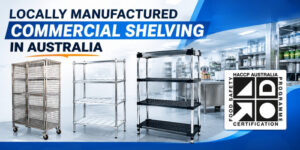
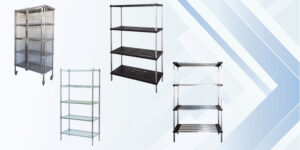
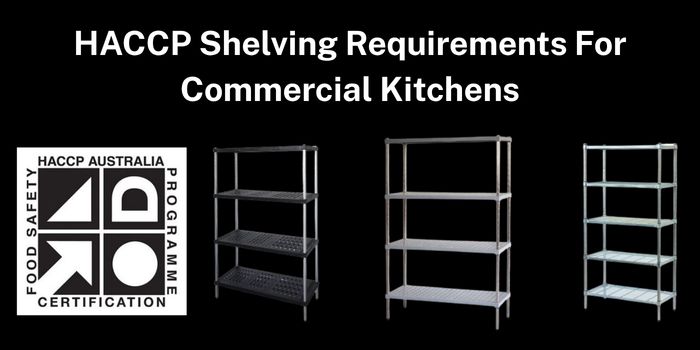
Stainless Steel (Grade 304 and 316) remains the gold standard for commercial kitchen shelving in Australia. Its non-porous, smooth surface resists bacterial growth, withstands regular cleaning with industrial sanitisers, and handles humid environments without corroding. Grade 316 offers superior resistance in coastal or high-moisture kitchens.
High-Density Polyethylene (HDPE) shelving is an acceptable alternative in certain dry storage and cool room applications. It resists moisture, does not corrode, and supports regular sanitation. However, HDPE can warp under heavy loads and is generally less suitable for high-temperature zones.
Coated wire shelving is acceptable in limited circumstances, provided the coating remains fully intact. Once the coating chips or peels, the underlying metal becomes exposed to moisture, corrosion, and bacterial build-up — at which point the shelf immediately fails HACCP compliance.
Materials you must avoid include raw or unsealed timber, painted mild steel, rusted metals, and unsealed MDF or particleboard. These materials are porous, difficult to sanitise, and absorb moisture and bacteria over time. They will almost certainly result in a failed food safety audit.
Explore Mantova’s full range of HACCP-approved shelving materials to find the right option for your specific kitchen environment.
Structural and Design Requirements
Beyond material selection, the physical structure of your shelving must comply with both FSANZ standards and AS 4674-2004. Specifically, the following design requirements apply to all commercial kitchen shelving in Australia:
- Minimum floor clearance of 15 cm (6 inches): All shelving must sit at least 15 centimetres off the floor. This clearance allows cleaning staff to sweep and mop underneath, and it removes easy pest access points along the base of the unit.
- No sharp edges or exposed crevices: Shelving must be free of sharp edges, open joints, or crevices that trap food particles and harbour bacteria. Welded joints must be smooth and continuous.
- Adequate wall and ceiling clearance: Shelves must allow sufficient airflow and access for cleaning behind and around units.
- Load-bearing integrity: Shelves must carry their intended load without bending, warping, or shifting, as structural failure creates both a physical contamination hazard and a workplace safety risk.
- Adjustable shelving: Adjustable shelf heights allow operators to adapt storage configurations as their HACCP plan evolves — a practical advantage during EHO inspections.
In addition, open-frame shelving designs generally outperform solid-base designs in commercial kitchens because they allow better airflow, reduce moisture accumulation, and make visual inspection of stored items much easier.
Placement, Zoning, and Cross-Contamination Prevention
Proper shelving placement is as important as material selection. Specifically, HACCP principles require strict separation between different food categories and between food and non-food items.
Separate raw foods from ready-to-eat foods. Raw meats, poultry, and seafood must occupy shelving below or entirely separate from ready-to-eat produce, dairy, and cooked items. This prevents drip contamination — one of the most common causes of foodborne illness in commercial kitchens.
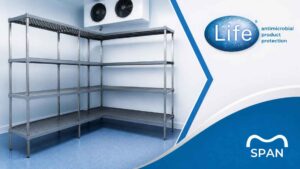
Cold storage shelving in cool rooms, fridges, and freezers must allow adequate airflow around stored products to maintain consistent temperature across the unit. Additionally, shelving in these environments must resist condensation and not corrode in high-humidity conditions — a key reason stainless steel and HDPE are preferred.
Dry storage shelving must be positioned away from chemical storage areas, external walls (to prevent moisture ingress), and drains or splash zones. Ventilation around dry storage shelves helps control humidity and extends the shelf life of stored goods.
Chemical storage requires completely dedicated shelving, clearly labelled, and positioned well away from any food storage or food preparation zone. Under no circumstances should cleaning agents, sanitisers, or pesticides share shelving with food products.
Allergen management is an increasingly important zoning consideration. Dedicated shelving — or at minimum, strictly enforced labelling protocols — must support the separation of common allergens including nuts, gluten-containing products, dairy, and shellfish.
Browse Mantova’s commercial shelving range to find zoning-ready solutions designed specifically for Australian food businesses.
Cleaning, Sanitation, and Documentation Requirements
HACCP compliance does not stop at installation. Ongoing cleaning and sanitation of shelving forms a documented part of your food safety program.
All shelving must be either cleanable in place or easily removable for thorough cleaning. Wire shelving and open-frame stainless steel units are particularly easy to clean in place with approved food-safe sanitisers. Solid shelf surfaces require careful attention to edges and underside surfaces where build-up can occur undetected.
Establish and document a cleaning schedule as part of your HACCP records. This schedule should specify the frequency of cleaning for each storage zone (e.g., daily for cold storage, weekly for dry storage), the approved cleaning agent, and the staff member responsible. During EHO inspections, auditors will ask to see these records — and the absence of documentation is treated as a compliance failure, regardless of how clean the shelves actually appear.
Common inspection failure points include rust on coated wire shelving, build-up in shelf bracket slots, warped or cracked HDPE, and chipped coatings on painted shelves. Addressing these proactively keeps your kitchen compliant between scheduled audits.
State and Territory Regulatory Variations
While FSANZ sets the national baseline, enforcement and additional requirements vary across Australian states and territories. Therefore, operators must engage with their local regulatory authority as well as the national code.
Key state bodies include the NSW Food Authority, SafeFood Queensland, the Victorian Department of Health, SA Health, and equivalent agencies in WA, Tasmania, the ACT, and the NT. Each body may impose additional fit-out requirements, inspection frequencies, or approval processes for new commercial kitchen builds or significant renovations.
Furthermore, local councils play an active role through environmental health officers who conduct routine and complaint-driven inspections. Before undertaking any new kitchen fit-out, obtain council approval and confirm that your HACCP documentation — including shelving specifications — meets local requirements.
Key Points: HACCP Shelving Requirements in Australia
- HACCP applies to shelving as part of the physical food safety environment, not just food-handling processes.
- FSANZ Standard 3.2.3 mandates that all shelving materials be food-safe, non-porous, and easy to clean.
- Stainless steel Grade 304 or 316 is the preferred shelving material in Australian commercial kitchens.
- A minimum 15 cm floor clearance is required for all shelving to support pest control and cleaning access.
- Raw and ready-to-eat foods must occupy separate shelving zones to prevent cross-contamination.
- Chemical storage shelving must be completely separate from all food storage areas.
- Cold room shelving must allow airflow and resist condensation and corrosion.
- Cleaning schedules for shelving must be documented and maintained as part of your HACCP records.
- State and territory bodies may impose requirements in addition to the national FSANZ Code.
- Regular self-auditing of shelving condition — checking for rust, chips, cracks, and build-up — prevents compliance failures between formal inspections.
HACCP Shelving Self-Audit Checklist
Use this checklist to assess your commercial kitchen shelving before your next inspection:
- All shelving constructed from approved, non-porous materials (stainless steel or food-grade HDPE)
- Minimum 15 cm clearance from the floor on all units
- No rust, chips, cracks, exposed joints, or sharp edges present
- Clear separation between raw food, ready-to-eat food, and chemical storage zones
- Cold storage shelves maintain adequate airflow and show no corrosion
- Cleaning schedules are documented and up to date
- FIFO (First In, First Out) system supported by shelf layout and labelling
- All shelving is included in the current HACCP plan documentation
- State or territory-specific requirements confirmed with local authority
- Staff understand and follow the documented shelving cleaning procedures
FAQs: HACCP Shelving Requirements in Australia
1: What materials are approved for HACCP-compliant shelving in Australian commercial kitchens?
Australian food safety standards, specifically FSANZ Standard 3.2.3 and AS 4674-2004, approve shelving materials that are non-porous, smooth, corrosion-resistant, and easy to clean. Stainless steel (Grade 304 or 316) is the most widely used and recommended material. Food-grade HDPE is acceptable in certain cool room and dry storage applications. Operators must avoid raw timber, painted mild steel, unsealed MDF, and any material with a chipped or deteriorating surface coating, as these harbour bacteria and fail HACCP compliance.
2: How far off the floor must shelving be in an Australian commercial kitchen?
Under HACCP guidelines and AS 4674-2004, all commercial kitchen shelving must maintain a minimum clearance of 15 centimetres (approximately 6 inches) from the floor. This clearance allows kitchen staff to clean and sanitise underneath shelving units effectively, and it eliminates easy access points for pests such as rodents and cockroaches. During EHO inspections in New South Wales, Queensland, Victoria, and other states, inspectors specifically check floor clearance as part of their routine fit-out assessment.
3: Do HACCP shelving requirements differ between states in Australia?
The national baseline for commercial kitchen shelving comes from the Australia New Zealand Food Standards Code (FSANZ) and AS 4674-2004, which apply across all states and territories. However, state and territory bodies — including the NSW Food Authority, SafeFood Queensland, and the Victorian Department of Health — may apply additional requirements or enforce the national standards differently. Furthermore, individual local councils conduct inspections and may have specific approval requirements for new kitchen fit-outs. Operators should always confirm requirements with their local environmental health officer before completing a new kitchen build or renovation.
4: Can I use timber shelving in my Australian commercial kitchen?
No. Timber shelving — whether raw, painted, or sealed — does not meet HACCP shelving requirements for Australian commercial kitchens. Timber absorbs moisture, harbours bacteria, and resists proper sanitisation with the cleaning agents used in commercial food environments. FSANZ Standard 3.2.3 requires food premises operators to use equipment and fittings made from materials that prevent food contamination and allow easy cleaning and sanitisation. An EHO inspector will flag timber shelving as a compliance failure, and your business may receive a formal improvement notice. Choose HACCP approved shelving for coolrom and your commercial kitchens.
5: How often should commercial kitchen shelving be cleaned under a HACCP plan?
Your HACCP plan must include a documented cleaning schedule that specifies the frequency, method, and responsible staff member for cleaning each shelving zone. As a general guide, cold storage shelving (fridges, freezers, and cool rooms) should be cleaned and sanitised at least weekly, while dry storage shelving requires cleaning at least fortnightly or whenever visible soiling occurs. High-traffic shelving adjacent to food preparation areas may require daily cleaning. Critically, your documented records must reflect actual practice — auditors review cleaning logs during inspections, and undocumented cleaning carries the same compliance risk as no cleaning at all.
Conclusion: Trust Mantova for HACCP-Compliant Shelving in Australia
Meeting HACCP shelving requirements in Australia demands more than simply buying stainless steel shelves — it requires a thorough understanding of material standards, structural specifications, zoning obligations, cleaning protocols, and state-specific regulatory requirements. Every shelf in your commercial kitchen plays an active role in your food safety system, and every compliance gap carries real business risk.
Mantova brings decades of expertise in supplying HACCP-approved commercial kitchen shelving to Australian food businesses, from busy urban restaurants and aged care facilities through to large-scale food manufacturing operations. Mantova’s product range is purpose-built to meet FSANZ standards and AS 4674-2004 specifications, giving operators confidence that their shelving will pass inspection and protect both their customers and their business. Whether you are fitting out a new kitchen or upgrading an existing one, Mantova’s team provides the product knowledge and compliance guidance you need to get it right.