Buying a Double Half Height Tray Trolley sounds straightforward — until it arrives and the trays don’t fit, the castors scratch your kitchen floor, or the frame starts corroding after three months of wash-downs. In a high-volume commercial kitchen, the wrong trolley creates real problems: blocked walkways, slow service, hygiene failures, and unnecessary replacement costs.
Whether you manage a hospital kitchen in Melbourne, a school canteen in Brisbane, an aged care facility in Perth, or a large catering operation in Sydney, this guide gives you a practical, no-fluff checklist for choosing the right Double Half Height Tray Trolley for your operation. Every point in this guide is based on real specifications and real-world kitchen requirements — so you can buy with confidence the first time.
What Is A Double Half Height Tray Trolley?
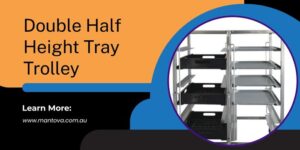
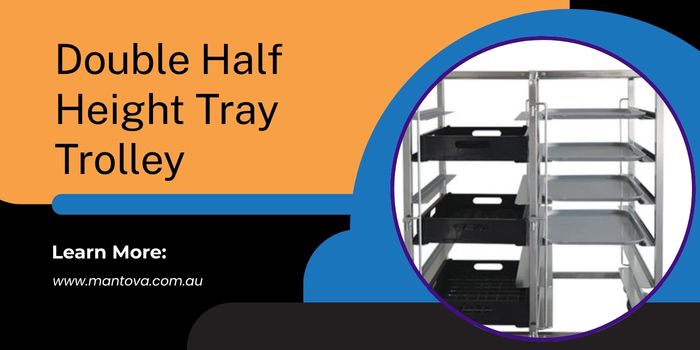
A Double Half Height Tray Trolley features two staggered rows of runners across a single compact frame, allowing you to store more trays within a smaller vertical footprint than a full-height single configuration. The overall height sits at 1170mm including castors — which is deliberately designed to sit at a comfortable working height for kitchen staff without requiring bending or overreaching during busy service periods.
The standard depth runs at 590mm, and the width customises to accommodate two times your specific tray size. This matters enormously because tray sizes vary across different kitchen operations. You should never assume a trolley will fit your trays without checking.
At 12 trays at 150mm spacing, a single Double Half Height Tray Trolley handles a serious tray volume while keeping each tray accessible and separated. That 150mm spacing prevents trays from sticking together, reduces cross-contamination risk, and makes it faster to load and unload during service.
Now that you understand the format, here is exactly what to check before you buy.
Material and Finish — Start Here, Not at the Price Tag
The single most important decision you make when buying a commercial tray trolley is the material. Everything else — hygiene performance, longevity, compliance — flows from this choice.
For Australian commercial kitchen environments, you should only consider 304 grade stainless steel. Here is why that grade specifically matters:
304 stainless steel contains a minimum of 18% chromium and 8% nickel, which gives it outstanding resistance to corrosion in humid, wet, and chemically active environments. Commercial kitchens involve constant moisture, steam, and frequent cleaning with commercial-grade sanitisers. Cheaper materials — chrome-plated steel, powder-coated frames, or zinc-plated finishes — begin deteriorating under these conditions within months. Once the coating breaks down, rust forms rapidly, and a rusting trolley is both a hygiene risk and a structural risk.
Mantova’s Double Half Height Tray Trolley uses a polished 304 grade stainless steel finish throughout. The polished surface is smoother than a brushed finish, which means bacteria have fewer microscopic surface irregularities to colonise, and your cleaning staff spend less time wiping it down.
The frame itself uses 25 x 25mm square 1.2mm stainless steel tube. That 1.2mm wall thickness is the specification you need for load-bearing stability. Thinner-walled tubes flex under repeated load and lateral stress, which eventually weakens welded joints. This frame specification handles the demands of daily commercial use without compromise.
Tray Compatibility — The Detail That Catches Most Buyers Out
More buyers get this wrong than any other specification. They order a trolley, it arrives, and their trays either slide through the runners or jam because the spacing is off.
The crossbar width on a Double Half Height Tray Trolley should match your specific tray dimensions — not a generic size. Mantova offers two width options, both configurable to suit your tray size. Before you order, measure your most commonly used trays and confirm the crossbar configuration with your supplier.
The runners themselves measure 50mm wide and 590mm deep, and Mantova MIG welds them to the frame rather than using spot welds or mechanical fasteners. MIG welding creates a continuous, full-penetration weld bead that is significantly stronger than spot welding. It also eliminates the small gaps that spot welds leave — gaps where food debris collects and bacteria grow.
At 150mm tray spacing, the trolley accommodates standard gastronorm trays comfortably without the trays touching each other. That clearance matters during service when staff are moving quickly and loading trays without precision.
Castors — The Component That Fails First on Cheap Trolleys
Castors take more punishment than any other component on a tray trolley. They roll across wet kitchen floors, over door thresholds, and carry full tray loads dozens of times per day. On cheap trolleys, castors are where the false economy shows up fastest.
Here is what the specification should include:
Size: 125mm diameter is the right castor size for commercial kitchen use. Smaller castors struggle across uneven tiles and rubber matting, require more force to move, and wear faster under load. Larger castors raise the trolley height unnecessarily.
Material: Rubber castors are quieter than hard plastic, gentler on floor surfaces, and provide better grip on wet tiles — which is a genuine safety consideration. Hard plastic castors are noisier, cause more floor damage over time, and offer less traction on slippery surfaces.
Locking: Mantova’s Double Half Height Tray Trolley includes 4 x 125mm rubber locking castors with 2 locking. Two locking castors provide sufficient stability to prevent the trolley rolling during loading and unloading. When you position the trolley at a service station, the last thing you want is it drifting away from a staff member holding a full tray.
Replaceability: Before you buy any trolley, ask whether replacement castors are available as individual components. This is a question most buyers forget to ask. When a castor eventually wears out — and it will — you should be able to replace it individually rather than replacing the entire trolley.
Hygiene and Cleaning Design — Non-Negotiable in Any HACCP Environment
In a HACCP-compliant kitchen, every piece of equipment needs to support your cleaning and sanitation protocols — not work against them. A tray trolley that is difficult to clean is a liability, regardless of how well it is built.
When you assess a Double Half Height Tray Trolley for hygiene performance, check these specific design features:
Tray locks: Mantova designs its tray locks for easy cleaning — no hidden crevices or complex mechanisms where food debris accumulates between service periods. Simple, smooth, accessible locking mechanisms clean quickly during your regular sanitation schedule.
Open frame construction: The open frame design gives cleaning staff full access to every surface — between runners, underneath the frame, and around the castor housings. Closed-panel designs trap moisture and debris in areas that are impossible to reach with standard cleaning equipment.
Welded joints vs bolted joints: Fully welded construction eliminates bolt threads, washers, and mechanical joint gaps. Every gap in a commercial kitchen is a potential contamination site. Welded construction removes those gaps entirely.
Polished surface finish: A polished stainless steel surface is faster to wipe down and leaves fewer residual moisture spots than a brushed or matte finish. In a busy kitchen environment, that difference in cleaning time adds up significantly across a week of service.
Flat Pack Delivery — Why This Matters for Australian Buyers
Mantova supplies its Double Half Height Tray Trolley flat packed, and for Australian buyers — particularly those outside major metro areas — this is a genuinely practical advantage worth understanding.
Flat pack delivery reduces freight volume significantly, which directly reduces your delivery cost. If you are purchasing for a facility in regional Queensland, South Australia, or Western Australia, the freight saving on a flat packed trolley versus a fully assembled unit can be substantial.
Flat pack also means the delivery fits through standard doorways and corridors without requiring forklifts or specialist handling equipment. Your receiving team can manage the delivery without disrupting kitchen operations.
Assembly is straightforward. The welded frame components arrive pre-assembled — the welded sections that give the trolley its structural integrity are not field-assembled. You are connecting pre-built sections, not building from scratch. All fixings should be included in the pack.
Compliance With Australian Food Safety Standards
Any tray trolley operating in an Australian commercial kitchen should actively support your HACCP compliance obligations, not simply avoid breaching them.
HACCP — Hazard Analysis and Critical Control Points — is the food safety management framework that governs commercial kitchen operations across Australia. For equipment, HACCP compliance means materials must be food-safe, non-toxic, non-absorbent, and fully cleanable.
304 grade stainless steel satisfies all of these requirements. It is non-porous, non-reactive with food contact surfaces, resistant to the sanitising chemicals used in commercial kitchens, and does not absorb moisture or harbour bacteria within its material structure.
Mantova holds HACCP Australia Approval across its product range. That approval means an independent body has assessed the products against food safety management standards — it is not a self-declared claim. For procurement officers and facility managers who need to document equipment compliance for audits, HACCP approval from a recognised body is the specification to request from any supplier.
Supplier Credibility and Local Support
Buying commercial kitchen equipment from an Australian manufacturer with local stock and local support is a practical advantage that becomes obvious the moment something goes wrong or you need a replacement part quickly.
Mantova has manufactured commercial kitchen equipment in Australia since 1969 — over 55 years of local manufacturing, local support, and products engineered specifically for Australian kitchen environments. The Southern Sydney manufacturing facility uses Australian recycled materials wherever possible, which means shorter supply chains and faster replacement part availability compared to imported alternatives.
When you buy from a local manufacturer, you also gain access to direct technical advice on specifications like crossbar width configuration — the kind of detail that makes the difference between a trolley that works perfectly for your operation and one that creates daily frustration.
Key Points For Buying a Double Half Height Tray Trolley
Always measure your trays first — confirm crossbar width compatibility before ordering, not after
- Specify 304 grade stainless steel — it is the only material that performs reliably in wet, chemical-intensive Australian commercial kitchen environments
- Check wall thickness on the frame — 1.2mm tube thickness is the minimum specification for load-bearing commercial use
- Confirm MIG welding on runners — MIG welding is stronger and more hygienic than spot welding or mechanical fastening
- Choose rubber castors over hard plastic — quieter, safer on wet floors, and gentler on kitchen flooring
- Verify locking castor configuration — two locking castors is the minimum for stable service-position use
- Assess cleaning access before buying — open frame construction and smooth polished finishes clean faster and more thoroughly
- Ask about replacement castor availability — individual castor replaceability extends trolley lifespan significantly
- Request HACCP approval documentation — particularly important for hospital, aged care, and school canteen procurement
- Factor in flat pack freight savings — especially relevant for buyers in regional Australia or those purchasing multiple units
FAQs For Buying a Double Half Height Tray Trolley
How many trays does a Double Half Height Tray Trolley hold?
The standard configuration holds 12 trays at 150mm spacing. That spacing keeps trays separated to prevent sticking, support airflow, and reduce cross-contamination risk between trays during storage and transport within the kitchen.
Is the Double Half Height Tray Trolley suitable for use in a cool room or freezer?
304 grade stainless steel performs reliably across a wide temperature range, including refrigerated and frozen environments. The material does not corrode, degrade, or become brittle under cool room or freezer conditions. You should confirm rubber castor performance in sub-zero temperatures with your supplier if you intend to use the trolley in a freezer environment regularly.
How difficult is it to assemble a flat packed Double Half Height Tray Trolley?
Assembly is straightforward. The structurally critical welded frame components arrive pre-assembled. You connect the pre-built sections using the fixings supplied in the pack. No specialist tools or technical knowledge are required. Most commercial kitchen teams complete assembly without any external assistance.
Where can I buy a Double Half Height Tray Trolley in Australia?
Mantova distributors supplies Double Half Height Tray Trolleys directly to commercial kitchens, hospitals, aged care facilities, school canteens, and catering operations across Australia. With manufacturing based in Southern Sydney and national delivery available, Mantova services buyers in Sydney, Melbourne, Brisbane, Perth, Adelaide, and regional areas across the country.
How do I clean a stainless steel tray trolley in a commercial kitchen?
Wipe down all surfaces with a food-safe sanitising solution using a non-abrasive cloth after each service period. The polished 304 stainless steel surface does not require specialist cleaning products. Avoid steel wool or abrasive pads, which scratch the polished surface and create microscopic grooves where bacteria can accumulate. For deeper cleaning, the open frame design allows full access to runners, joints, and castor housings.
Final Word
Buying the right Double Half Height Tray Trolley comes down to eight things: material grade, frame specification, tray compatibility, runner welding quality, castor specification, hygiene design, compliance credentials, and supplier reliability. Get all eight right and you buy once. Cut corners on any of them and you pay again within 12 to 18 months.
Mantova has built commercial kitchen equipment in Australia for over 55 years. Every specification in its Double Half Height Tray Trolley — from the 304 grade polished stainless steel frame to the MIG welded runners and 125mm rubber locking castors — reflects the real demands of Australian commercial food service environments.
Ready to configure your Double Half Height Tray Trolley to suit your tray size? Contact the Mantova team today for a direct recommendation.